Tổng hợp bài mẫu Speaking IELTS band 7.0+ mới nhất 2026
Nội dung quan trọng:
- Phần thi Speaking trong IELTS kéo dài khoảng 11–14 phút, gồm 3 phần chính: Part 1 – Personal Interview (4–5 phút); Part 2 – Long Turn (3–4 phút); Part 3 – Discussion (4–5 phút).
- Bài thi Speaking được đánh giá dựa trên 4 tiêu chí chính: Fluency & Coherence; Lexical Resource; Grammatical Range & Accuracy; Pronunciation.
- Bài viết tổng hợp nhiều bài mẫu Speaking IELTS band 7.0+ mới nhất 2026, bao gồm cả 3 phần: Speaking part 1, Speaking part 2, Speaking part 3.
Nếu bạn đang loay hoay tìm bài mẫu Speaking IELTS thật tự nhiên để luyện thi, đây là trọn bộ bài mẫu Band 7.0+ được biên soạn theo từng Part và chủ đề thường gặp. Mỗi bài đều kèm từ vựng nổi bật, cách phát triển ý và mẹo nói tự tin như thí sinh đạt band cao, giúp bạn nói trôi chảy mà không cần học thuộc khuôn mẫu.
1. Tổng quan về kỹ năng Speaking trong IELTS
1.1. Cấu trúc bài thi Speaking
Phần thi Speaking trong IELTS kéo dài khoảng 11–14 phút, gồm 3 phần chính:
- Part 1 – Personal Interview (4–5 phút): Giám khảo sẽ hỏi bạn những câu hỏi đơn giản về bản thân như sở thích, công việc, gia đình, quê quán… Đây là phần giúp bạn khởi động và thể hiện sự tự tin ban đầu.
- Part 2 – Long Turn (3–4 phút): Bạn sẽ được phát 1 cue card với chủ đề bất kỳ (ví dụ: “Describe your favorite book”) và có 1 phút chuẩn bị trước khi nói liên tục trong 1–2 phút.
- Part 3 – Discussion (4–5 phút): Đây là phần thảo luận mở rộng với các câu hỏi mang tính trừu tượng, đòi hỏi khả năng diễn đạt quan điểm cá nhân và tư duy logic.
Việc hiểu rõ cấu trúc bài thi là nền tảng để bạn có thể luyện Speaking IELTS một cách có hệ thống, tránh lạc hướng trong quá trình ôn tập.
1.2. Các tiêu chí chấm điểm IELTS Speaking
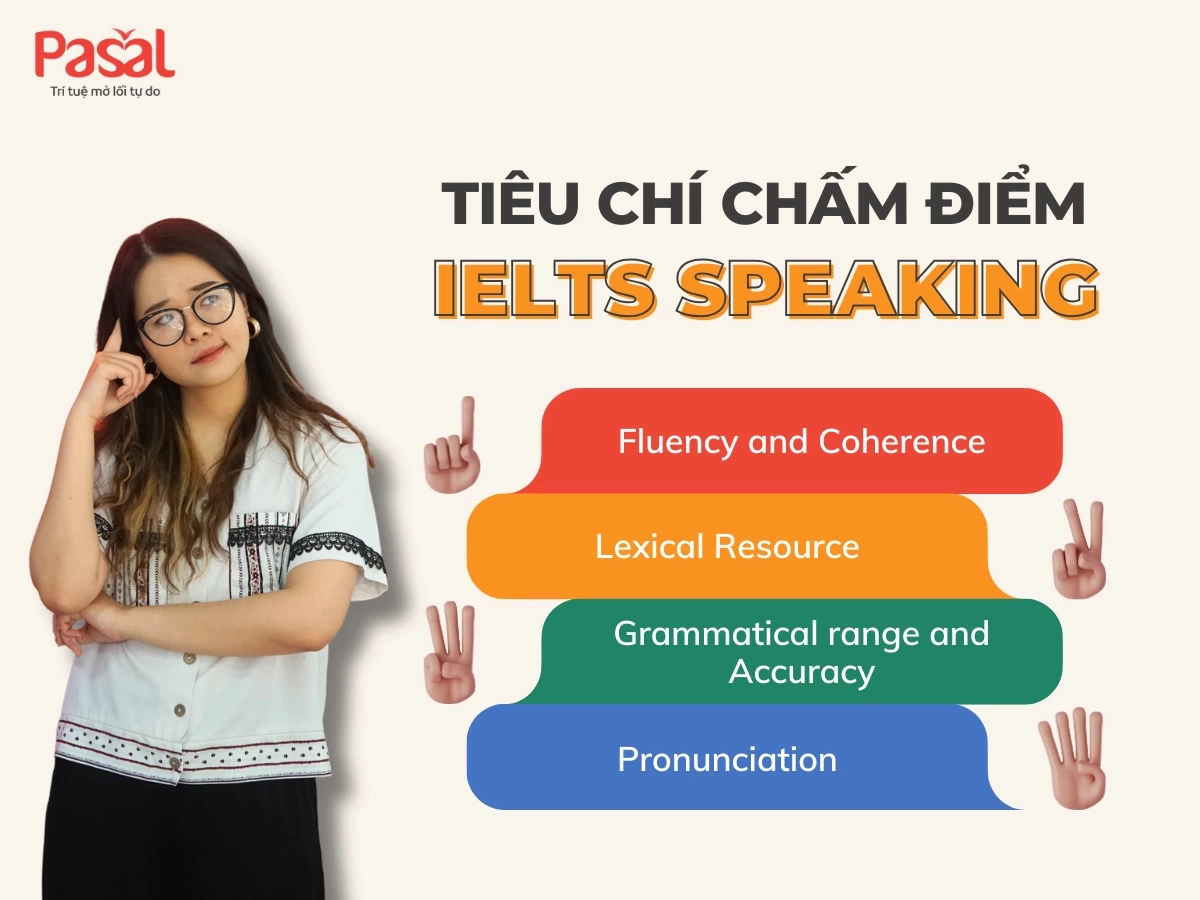
Bài thi Speaking được đánh giá dựa trên 4 tiêu chí chính:
- Fluency & Coherence: Độ trôi chảy và mạch lạc khi nói.
- Lexical Resource: Vốn từ vựng đa dạng, phù hợp ngữ cảnh.
- Grammatical Range & Accuracy: Khả năng sử dụng cấu trúc ngữ pháp chính xác và linh hoạt.
- Pronunciation: Cách phát âm rõ ràng, tự nhiên và dễ hiểu.
Nếu bạn muốn đạt band từ 6.5 trở lên, không thể chỉ học mẹo mà cần luyện nói đều đặn để cải thiện thật sự cả 4 tiêu chí này.
1.3. Những thách thức phổ biến khi luyện Speaking
Rất nhiều thí sinh Việt Nam gặp những rào cản giống nhau khi bắt đầu luyện Speaking IELTS:
- Ngại nói, sợ sai, dẫn đến nói nhỏ, ngập ngừng, thiếu tự tin.
- Thiếu từ vựng, khiến câu trả lời bị ngắn, lặp từ.
- Không biết phát triển câu trả lời, khiến Part 2 và Part 3 đặc biệt khó khăn.
Pasal đã gặp hàng nghìn trường hợp học viên rơi vào tình huống tương tự, và tất cả đều có thể cải thiện rõ rệt chỉ sau 4-8 tuần nếu luyện đúng phương pháp.
2. Tổng hợp bài mẫu Speaking IELTS từ Cựu giám khảo Simon Corcoran
2.1. Bài mẫu Speaking IELTS part 1
Chủ đề: Future plans
- What job would you like to have ten years from now?
I’d like to think that I’ll be doing the same job in ten years’ time. I like being a scientist, so I can’t imagine changing my profession.
- How useful will English be for your future?
English is essential in my field of work; most of the research that is being done in this area is published in English, so I read articles and papers in English every day.
- How much travelling do you hope to do in the future?
I’d like to see more of the world, so it would be nice to be able to travel extensively at some point, maybe when I’m retired.
- How do you think your life will change in the future?
Hopefully I’ll make progress in different areas of my life, for example at work and in terms of my home life. I’m also interested to see what new technologies come along in the next decade or two.
Chủ đề: 2. Taking photos
- What type of photos do you like taking?
Well, I don’t usually take photos to be honest. I prefer to enjoy whatever I’m doing, rather than stop to take a photograph.
- What do you do with photos you take?
I don’t really do anything with the occasional photos that I take. They just stay on my phone and I forget to save them or upload them to my computer.
- When you visit other places, do you take photos or buy postcards?
Neither. As I said, I prefer to enjoy myself, so I tend to let other people take photos. I used to buy and send postcards when I was younger, so maybe I should go back to doing that.
- Do you like people taking photos of you?
As a child I was always a bit shy when it came to having my photo taken, so I would have said that I didn’t like it. These days, if someone wants to take a photo of me, I don’t mind at all.
Chủ đề 3: Friends
- Are your friends mostly your age or different ages?
Most of my friends are about the same age as me because we met at school or university. I’ve got one or two friends who are older or younger that I met through work.
- Do you usually see your friends during the week or at weekends?
I tend to meet up with my friends at weekends because everyone’s too busy during the week.
- The last time you saw your friends, what did you do together?
It was one of my friends’ birthdays last weekend. Six of us went out for a meal to celebrate.
- In what ways are your friends important to you?
I think it’s important to have friends that you can talk to and share experiences with. My friends make me laugh, but I know I can also rely on them whenever I need help or support.
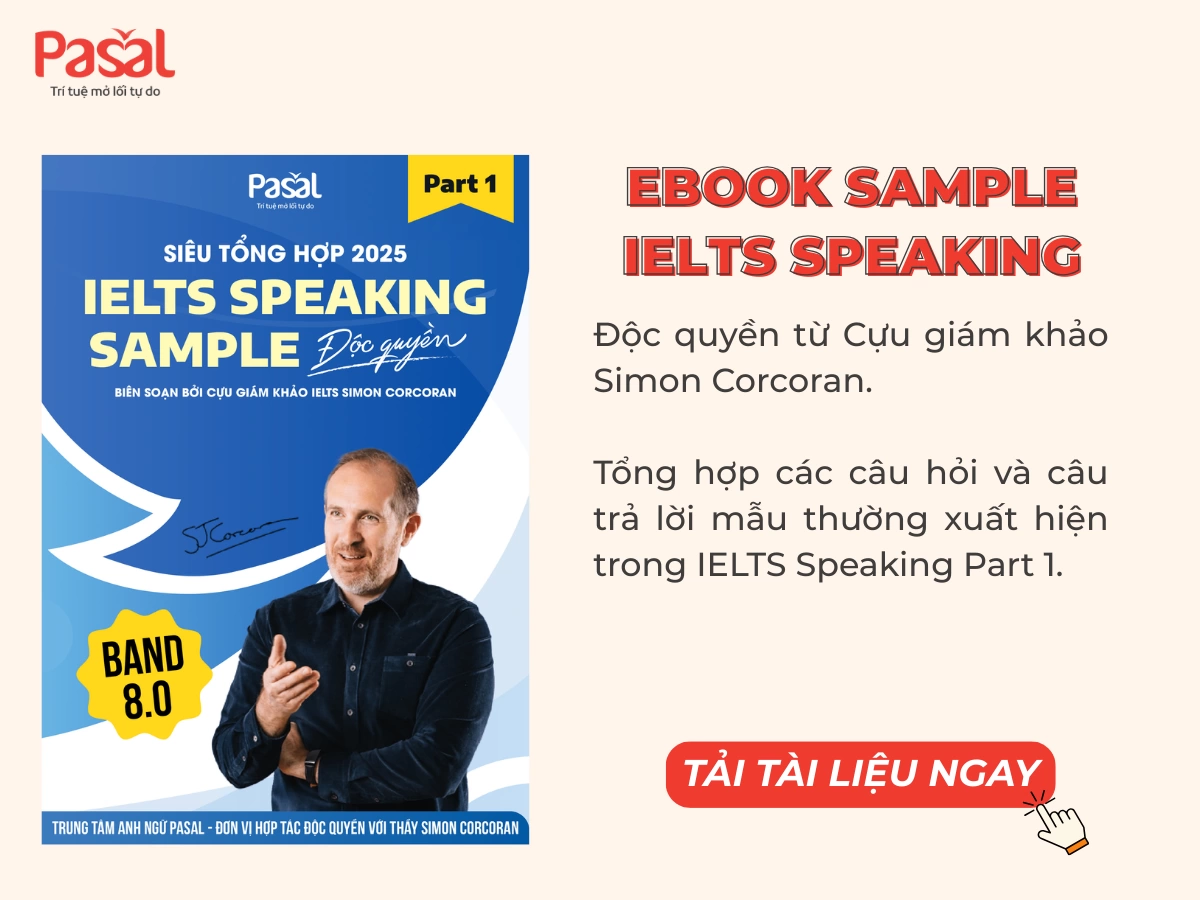
Tải ngay Ebook: Siêu tổng hợp IELTS Speaking Sample (Part 1) biên soạn bởi Cựu giám khảo Simon Corcoran – Độc quyền tại Pasal
2.2. Bài mẫu Speaking IELTS part 2
Đề số 1: Describe a bad service
Describe a time when you were not satisfied with a service. You should say:
- what the service was
- who provided it
- what happened and explain why you were unhappy with the service.
I’m going to describe a time when I experienced poor service from staff in a restaurant. This happened a couple of months ago, when some family members, who live abroad, came to stay. We decided to visit a nearby town, and at some point everyone was a little hungry, so we thought we would have a bite to eat.
The first restaurant that we came across looked perfect. It had plenty of empty tables – we hadn’t booked in advance – and we were all happy with the menu. But as soon as we walked through the door, things started to go wrong, and we weren’t at all impressed with the attitude of the staff.
After standing around for a few minutes waiting for someone to greet us, I managed to attract the attention of a waitress who told me that we had come into the restaurant through the wrong door. So, I went over to the main door, only to be told by the manager that there were no tables free for a party of our size – there were eight of us. I could see several free tables with four seats, so I suggested simply moving two of these tables together. But the manager was adamant that this was impossible; our only option was to divide the family and sit at two separate tables.
By this time, some of my family members were getting fed up. The restaurant was half empty, yet we were being treated as if they didn’t need customers. We decided we didn’t want to sit at separate tables or stay in a place where we felt unwelcome. We left, feeling disappointed by how dismissive the restaurant manager had been, and fortunately we found a much friendlier place to eat just around the corner.
Đề số 2: Describe a book
Describe a book that you enjoyed reading because it made you think a lot. You should say:
- what this book was
- why you decided to read it
- what reading this book made you think about and explain why you enjoyed reading this book.
I’m going to talk about a book that really made me think, and that has had a positive effect on my life. The name of the book is ‘Atomic Habits’, and it’s about the compounding effect that small decisions and minuscule changes can have on people’s lives.
I decided to read Atomic Habits after seeing an interview with the book’s author, James Clear, who is a world-renowned expert in the field of habit formation. In the interview, he told inspiring stories and revealed some simple life hacks that can make people more productive, motivated, and happy. I found the whole idea of the ‘science of tiny habits’ fascinating, and so I bought the book straight away.
While reading the book, I was forced to confront my own habits and behaviours. I realised that I’m nowhere near as productive as I could be, but that some small tweaks to my routine could make a significant and long-lasting difference. The book also gave me a framework to understand how good habits are formed and how bad habits can be broken. It has encouraged me to analyse my own habits accordingly.
I thoroughly enjoyed reading Atomic Habits because I thought it was well researched, well reasoned and well written. The author’s ideas and advice aren’t simply his opinions; they are taken from cutting-edge research and real success stories. I enjoy reading books that change my way of thinking in some way or give me practical, life-altering ideas, and this was definitely one of those books.
Đề số 3: Describe a skill
Describe a practical skill that you have learnt (e.g. cooking, driving). You should say:
- what the skill is
- how you learnt it
- why you learnt it and explain how this skill has helped you.
I’m going to talk about driving, which is a practical skill that I use almost every day. I learnt to drive a car by taking lessons when I was 17. My parents paid for me to have lessons with a professional driving instructor. I learnt by practising: first I had to get used to steering, changing gears, and using the mirrors, then we practised things like reversing and parking. I also had to learn the highway code, which is the reference book for road signs and driving rules here in the UK.
As a 17-year-old, I think I was most attracted to the physical experience of driving: accelerating along a road, steering around a corner, and that kind of thing. On top of that, all of my friends were passing their driving tests, so there was a certain amount of peer pressure. I suppose driving also represented freedom and the beginning of adulthood; I was suddenly able to pop round to friends’ houses or go into the city centre without having to walk or catch a bus.
Being able to drive has helped me in so many ways. The public transport where I live isn’t very good, so I travel to work by car most days. Having a car makes my life much easier when it comes to things like shopping or visiting family and friends. A few weeks ago, my car was being repaired, and I had to walk to the train station and catch the train to work; that made me realise how important driving is to me.
Tải ngay Ebook: Siêu tổng hợp IELTS Speaking Sample (Part 2) biên soạn bởi Cựu giám khảo Simon Corcoran – Độc quyền tại Pasal
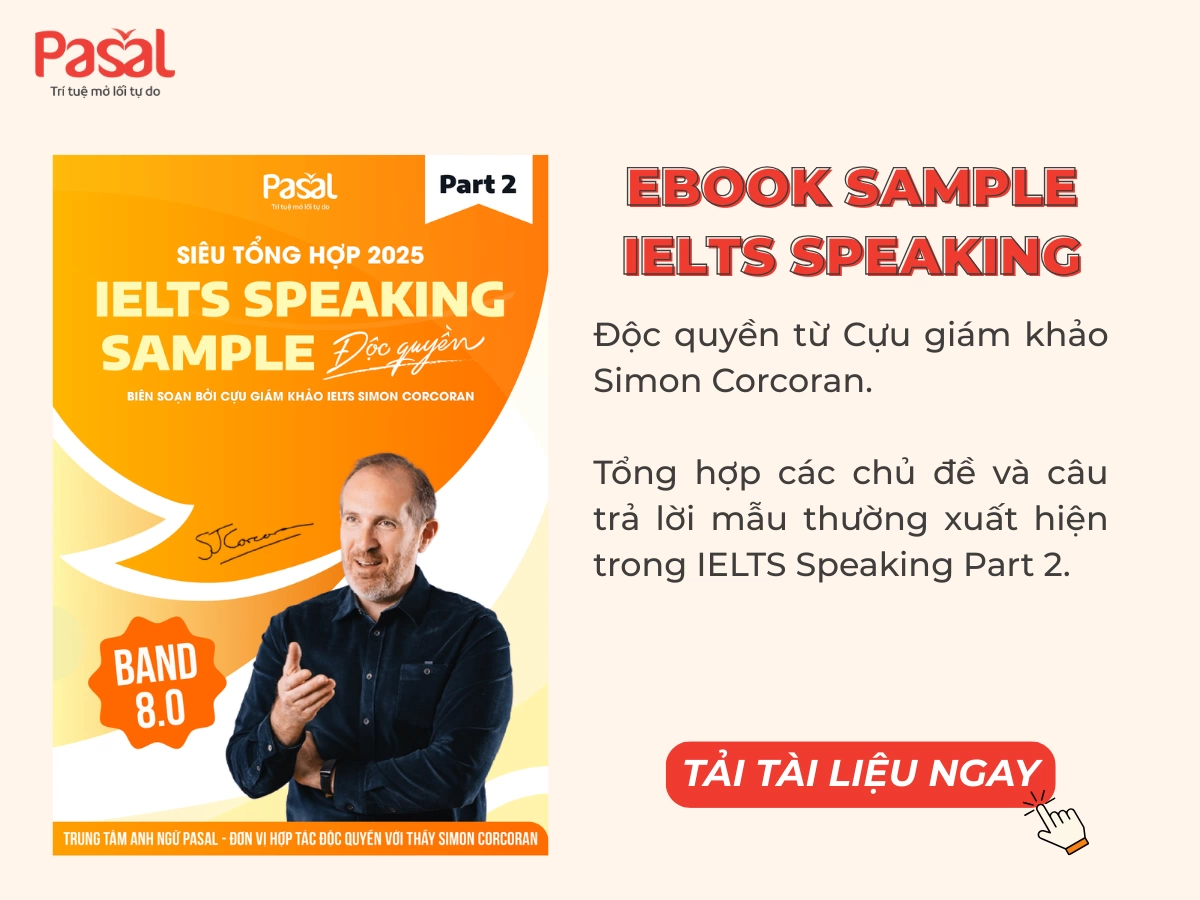
2.3. Bài mẫu Speaking IELTS Part 3
Chủ đề 1: Difficult jobs
- What are the most difficult jobs that people do?
I think jobs can be hard for various different reasons. Some professions, such as concert pianist or surgeon, are difficult in the sense that they require a high level of skill that must be developed through many years of study and practice. On the other hand, jobs like police officer, firefighter or soldier might not require such high skill levels, but they are known to be extremely stressful and sometimes traumatic.
- Why do you think some people choose to do difficult jobs?
I suppose we all want to do something meaningful. For some people, this means achieving a great ambition that takes years of hard work. People who choose dangerous jobs might do so for altruistic reasons or because they feel it’s their duty to contribute to society.
- Do you agree or disagree that all jobs are difficult sometimes?
I would have to disagree with that. I think we all feel that our jobs are difficult or stressful at times, but in the grand scheme of things we have nothing to complain about. A tight deadline or a lost computer file are really just minor inconveniences when compared with the horrors of war that soldiers face, or the life-and-death situations that paramedics see every day.
Chủ đề 2: Future predictions
- Will large shopping malls continue to be popular, despite the growth of internet shopping?
I can’t see shopping malls disappearing any time soon, so yes, I think they will definitely continue to attract shoppers. We already have internet shopping, with websites like Amazon now mainstream, but the large shopping centres in my city are still packed with people. The Trafford Centre near Manchester, for example, is hugely popular, and I think this is because it offers more than just shopping. It’s a place where families go for a day out, to have lunch or to visit attractions like Sea Life or Legoland, and naturally they will browse the shops and buy things there too.
- Do you think that some businesses (e.g. banks and travel agents) will only operate online in future?
I’m sure they will, and I think this is already happening. I’m pretty sure that there are online-only savings accounts, and there are travel websites like Airbnb that have no physical presence on the high street. I imagine that more and more services will only be available online; this seems to be the way that things are going.
Chủ đề 3: Good lesson
- What do you think makes a good lesson?
I think a good lesson is one that is interesting and engaging. By ‘engaging’ I mean that the students should feel involved in the lesson; they should feel that they are learning something new that is relevant to them. In my opinion, a lot depends on how the teacher delivers the content of the lesson in a way that students like. My favourite teacher at university used to involve the students by making us teach some of the lessons ourselves.
- Do you think it’s better to have a teacher or to teach yourself?
Well, there’s no substitute for a good teacher. I think you can teach yourself, but you can learn a lot more quickly with the guidance of a teacher. For example, when learning a language, you really need someone to correct your mistakes; you can get the grammar and vocabulary from books, but books can’t tell you where you’re going wrong.
- Do you think the traditional classroom will disappear in the future?
I don’t think it will disappear, but it might become less common. I think more people will study independently, using different technologies rather than sitting in a classroom. Maybe students will attend a lesson just once a week, and spend the rest of their time following online courses or watching video lessons.
Tải ngay Ebook: Siêu tổng hợp IELTS Speaking Sample (Part 3) biên soạn bởi Cựu giám khảo Simon Corcoran – Độc quyền tại Pasal
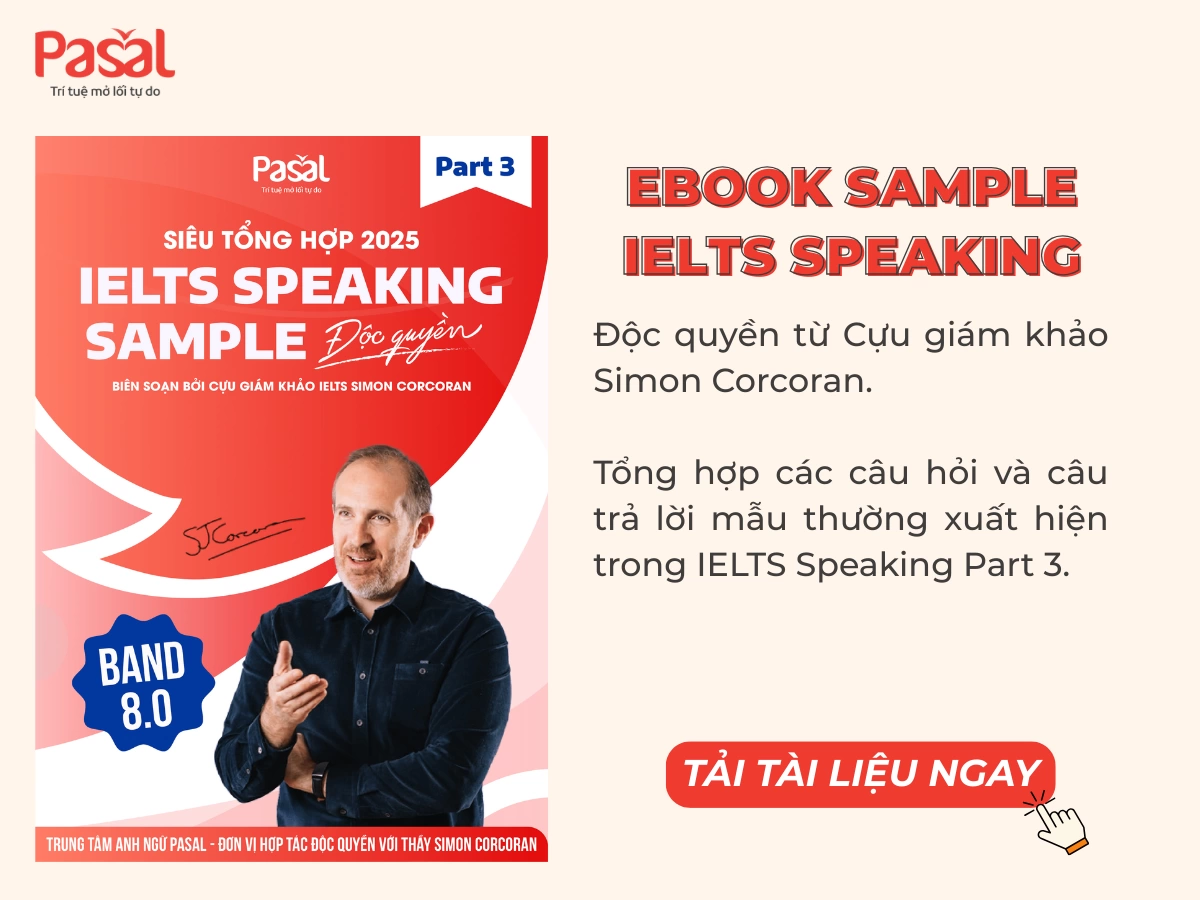
3. Cách luyện Speaking IELTS theo từng phần thi hiệu quả
Kỹ năng Speaking trong kỳ thi IELTS được chia thành 3 phần rõ ràng, mỗi phần có mục tiêu và cách đánh giá riêng. Người học muốn đạt band điểm cao cần hiểu rõ đặc trưng từng phần để có chiến lược luyện tập hiệu quả. Theo kinh nghiệm của Pasal, đây chính là giai đoạn “gỡ điểm” quan trọng, đặc biệt với những bạn vốn ngại nói hoặc thiếu phản xạ tiếng Anh.
2.1. IELTS Speaking Part 1 – Trả lời ngắn gọn, tự nhiên
Phần 1 thường được xem như khởi động của bài thi Speaking. Thí sinh sẽ trả lời khoảng 10 câu hỏi ngắn liên quan đến cuộc sống hằng ngày như sở thích, gia đình, công việc, đồ ăn, âm nhạc…
Tổng thời gian kéo dài khoảng 4-5 phút, tương đương 30 giây mỗi câu. Vì thời gian ngắn, bạn không cần trả lời quá dài, chỉ cần nói trọn vẹn một câu trả lời, đưa ra lý do và thêm một chi tiết ngắn.
Ví dụ, khi được hỏi “Do you prefer home-cooked food or food from restaurants?”, một câu trả lời phù hợp có thể là:
“I prefer home-cooked food because I think it’s healthier and I also enjoy cooking for my family and friends.”
Đây chính là kiểu trả lời lý tưởng: ngắn gọn, tự nhiên, đủ ý và tự tin. Sau khi trả lời, bạn nên dừng lại chủ động, nhìn giám khảo và sẵn sàng cho câu hỏi tiếp theo.
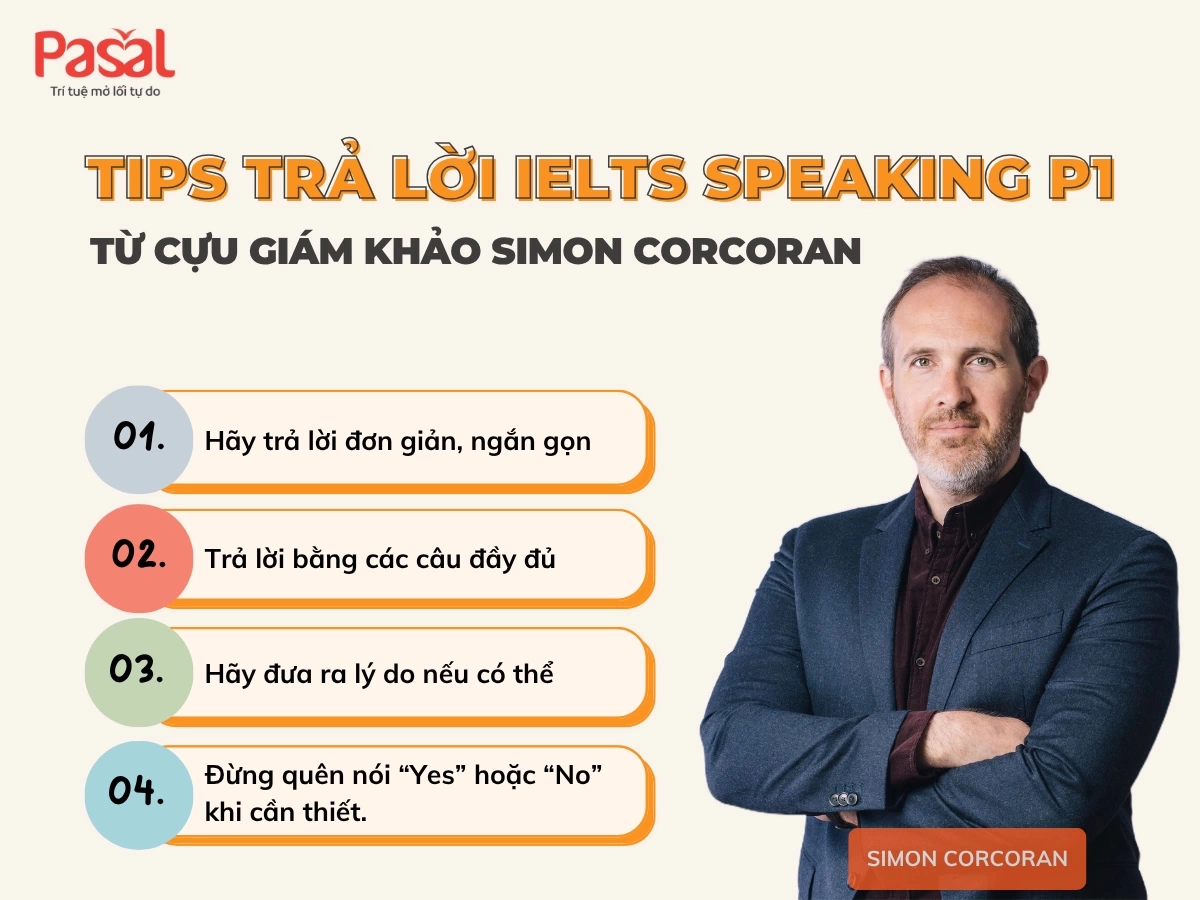
5 nguyên tắc vàng trong Part 1:
- Giữ câu trả lời ngắn, rõ ràng và kết thúc tự tin.
- Trả lời bằng câu đầy đủ, tránh trả lời cụt ngủn.
- Lặp lại một phần từ khóa trong câu hỏi vào câu trả lời.
- Nêu lý do cụ thể để tăng độ thuyết phục.
- Thêm “yes” hoặc “no” khi phù hợp để thể hiện phản xạ tự nhiên.
Mục tiêu của Part 1 không phải để khoe từ vựng khó, mà để chứng minh bạn có thể giao tiếp tự nhiên, lưu loát. Đây cũng là lúc giúp bạn “lấy đà” để bước vào phần 2 và 3 hiệu quả hơn.
2.2. IELTS Speaking Part 2 – Mô tả và triển khai ý
Speaking part 2 là lúc giám khảo thực sự bắt đầu đánh giá khả năng nói của bạn. Bạn sẽ được phát một tấm thẻ chứa chủ đề, có 1 phút chuẩn bị và 1–2 phút nói liên tục. Đây là phần đòi hỏi khả năng triển khai ý mạch lạc, có cảm xúc và ví dụ cụ thể.
Các nhóm chủ đề phổ biến:
- Favourites: sở thích cá nhân như sách, phim, âm nhạc, trang web yêu thích.
- People: một người nổi tiếng hoặc người thân trong gia đình.
- Activities: các hoạt động hằng ngày, sinh nhật, lễ hội, kỷ niệm đáng nhớ.
- Places: nơi bạn sống, từng đến hoặc muốn đến.
- Things: đồ vật thường dùng, món quà, vật kỷ niệm.
Thay vì học thuộc các mẫu câu dài, Pasal khuyên bạn nên chuẩn bị ý tưởng thật của chính mình. Việc dùng “formula phrases” (câu mẫu học thuộc) thường khiến phần trả lời nghe “giả tạo” và không ăn điểm cao, vì giám khảo dễ nhận ra bạn đang đọc lại câu nhớ sẵn. Quan trọng là bạn nói tự nhiên, có cảm xúc và mạch lạc.
3 bí quyết luyện Part 2 hiệu quả:
- Tận dụng 1 phút chuẩn bị: ghi nhanh các ý chính bằng tiếng Anh, không cần viết câu hoàn chỉnh.
- Đưa ví dụ thật: kể câu chuyện hoặc trải nghiệm cá nhân sẽ khiến câu trả lời sống động và đáng nhớ hơn.
- Đừng quá lo ngữ pháp: tập trung diễn đạt ý và từ vựng. Tự tin là chìa khóa giúp bạn nói trôi chảy hơn.
2.3. IELTS Speaking Part 3 – Thảo luận và mở rộng ý
Speaking part 3 thường là phần quyết định band điểm cuối cùng của bạn. Sau khi nghe bạn nói ở Part 2, giám khảo đã hình dung mức điểm và Part 3 sẽ là nơi họ xác nhận hoặc điều chỉnh đánh giá đó. Ở phần này, bạn sẽ nhận các câu hỏi mang tính học thuật hơn, yêu cầu phân tích, so sánh, đưa ý kiến và dự đoán tương lai.
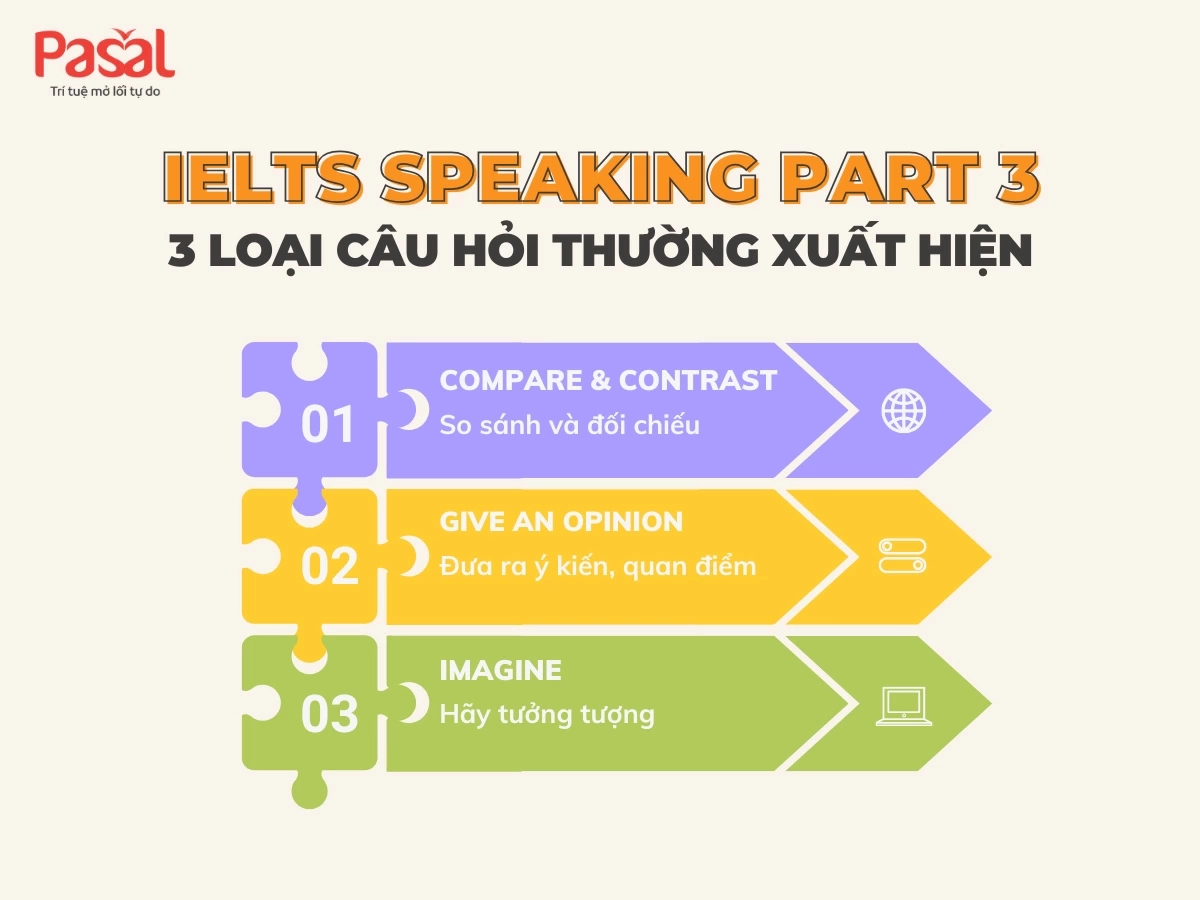
3 dạng câu hỏi phổ biến trong Part 3:
- So sánh – đối chiếu: Ví dụ “How is life different in cities compared to rural areas?”
- Đưa ý kiến: Ví dụ “How do you think life in big cities could be made easier?”
- Dự đoán tương lai: Ví dụ “What do you think cities will be like in 50 years?”
Để đạt điểm cao, bạn cần phát triển ý sâu hơn thay vì chỉ trả lời ngắn. Pasal gợi ý bạn dùng 3 kỹ thuật:
- Hỏi “tại sao” để giải thích rõ hơn quan điểm.
- Đưa ra phương án thay thế để tăng chiều sâu lập luận.
- Đưa ví dụ thực tế để minh chứng cho câu trả lời.
Ví dụ với câu hỏi “Are newspapers important?”, một câu trả lời tốt có thể là:
“Yes, newspapers are very important because they give us information about the world. If newspapers didn’t exist, the quality of news would suffer because there would be fewer professional journalists. We’d have to rely on bloggers who don’t always have the budget to research deeply.”
Ngoài ra, Part 3 cũng thường kiểm tra khả năng sử dụng thì quá khứ và tương lai. Nếu câu hỏi đề cập “50 years ago” hay “when your parents were young”, bạn nên dùng thì quá khứ đơn. Nếu câu hỏi nói “in 50 years” hay “in the future”, hãy sử dụng thì tương lai.
4. Kết luận
Tham khảo các bài mẫu Speaking IELTS là một trong những cách cải thiện kỹ năng nói hiệu quả. Bạn có thể học được nhiều từ vựng, mẫu câu, cách diễn đạt mới tự nhiên và phù hợp hơn. Tất nhiên, bạn cần kết hợp với luyện tập thực tế để tiến bộ nhanh chóng hơn. Nếu bạn vẫn đang vật lộn với Speaking, hay tham khảo ngay khoá học IELTS tín chỉ Speaking tại Pasal để được chấm, chữa cùng giảng viên 8.0+ IELTS nhé!


![Cách chấm điểm IELTS Speaking chi tiết nhất [Cập nhật 2025]](https://pasal.edu.vn/wp-content/uploads/2023/06/cach-cham-diem-ielts-speaking-thumb.webp)


![Nên thi IELTS vào tháng mấy để dễ đạt band cao? [Cập nhật 2026]](https://pasal.edu.vn/wp-content/uploads/2026/03/nen-thi-ielts-vao-thang-may-thumb.webp)